Power Grab Without a Coup
Viktor Orbán never stormed anything. He won a supermajority, rewrote the rules, and kept winning for sixteen years—the slow, legal self-coup, and the closest thing there is to a blueprint for what a determined leader can do while the elections keep running.
In 2010, Viktor Orbán's Fidesz party won two-thirds of Hungary's parliament. He never suspended the constitution or sent troops into the streets. He used a legitimate supermajority to rewrite the country's basic law, capture its courts, and reshape its elections—until Hungarians kept voting and the contest stopped being an even one. It held for sixteen years. Ending it took a landslide.
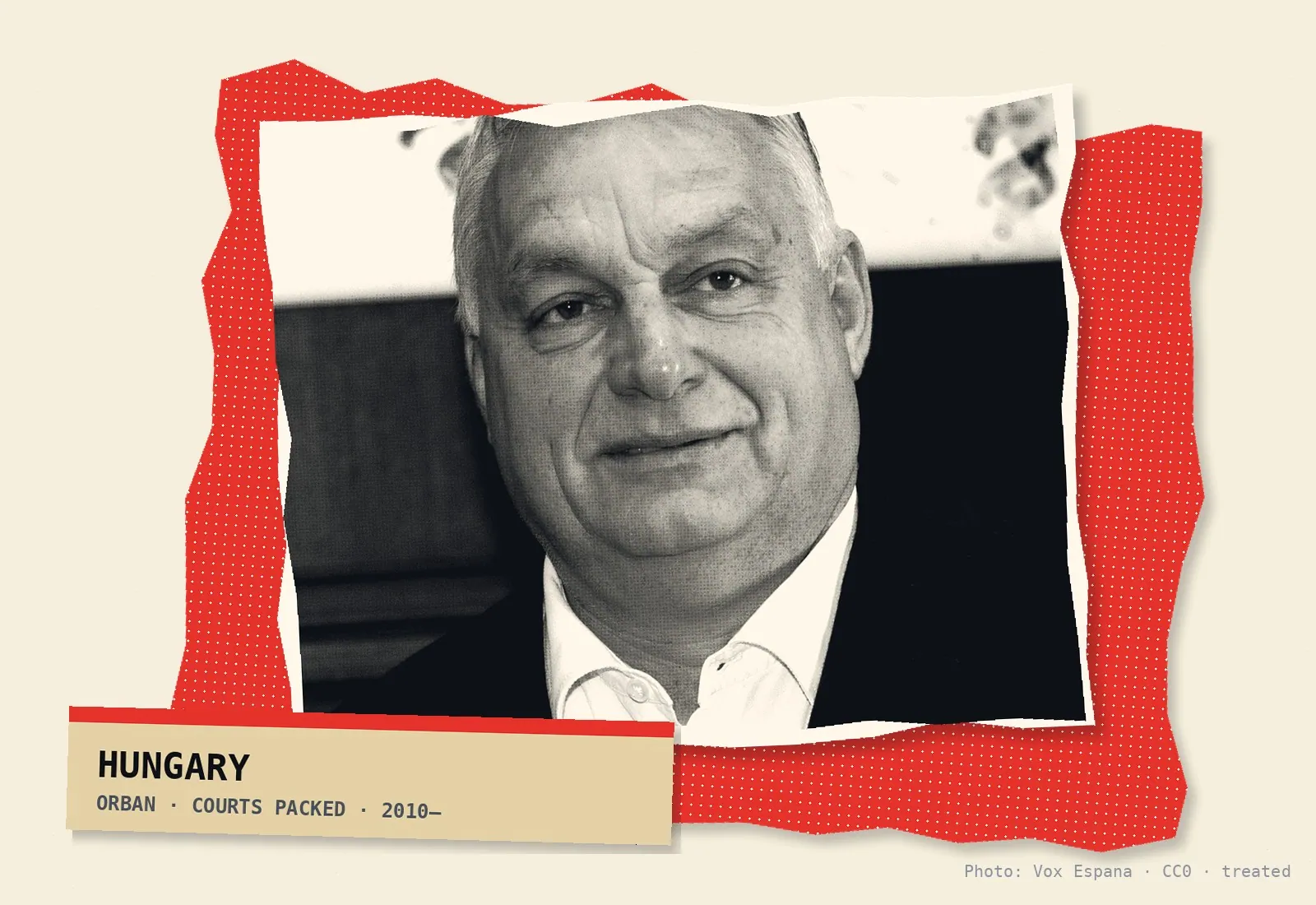
What Orbán did
- Rewrote the constitution. Used his supermajority to pass a new Fundamental Law in 2011, drafted without the opposition and reshaping the state around his party.
- Packed the Constitutional Court. Expanded its seats, changed the nomination rules, and filled it with loyalists—then cut the judicial retirement age to force out senior independent judges.
- Redrew the map. Rewrote the election law and district lines so the same share of the vote delivered far more seats to Fidesz.
- Captured the media. Allied businessmen bought up outlets and folded hundreds of them into a single pro-government conglomerate; public broadcasting became a state megaphone.
- Squeezed civil society. Drove the Central European University out of the country and put NGOs and universities under political and financial pressure.
- Kept the elections. Hungarians kept voting, and for sixteen years Fidesz kept winning—contests monitors repeatedly found genuine but tilted. Until April 2026.
The same moves, here
Orbán's is the quietest playbook—no tanks, no emergency, nothing to rally against—which is exactly why it maps so cleanly onto 2026. Every step was legal in form. That was the whole trick.
Orbán expanded the Constitutional Court, changed the nomination rules, and filled the new seats with loyalists. When senior judges got in the way, he lowered the judicial retirement age and retired them out of existence. Nothing was stormed; the referees were simply replaced.
The administration reached for the same result through a court ruling instead of a court-packing bill. Citing Trump v. Slaughter, the White House now claims the power to remove independent-agency officials at will—and has used it, firing all three remaining commissioners of the Election Assistance Commission months before the midterms. Judges who rule against it face impeachment talk; law firms that take the wrong clients face executive orders; and when courts have ruled the firings illegal, the firings have mostly stood anyway.
A new constitution drafted without the opposition, then a new election law and a new district map that turned the same share of the vote into far more seats. Fidesz didn’t need election-day fraud. It won each election before it started.
A mid-decade redistricting push aims to manufacture House seats before a single vote is cast. Homeland Security conditions election funding and demands voter rolls from the states. And the SAVE America Act would rewrite who can register at all—Trump priced that one himself at Mount Rushmore: pass it, "and we will not lose an election for a hundred years."
Allied businessmen bought up newspapers, radio, and television—then, in a single day in 2018, donated 476 outlets into one pro-government foundation. Public broadcasting became a state megaphone. No censor's office was ever required.
Here the pressure runs through balance sheets too. Paramount settled a lawsuit it would once have fought, with a merger pending before the government; the FCC floats license reviews after critical coverage; public media lost its federal funding; universities watch billions turn on their politics. Every newsroom now knows the price of a fight—which is the cheapest form of control there is.
Every step passed parliament legally. There was never an illegal order to refuse, never a decree to strike down—just lawmaking, at volume, by a party that controlled the lawmakers.
Schedule F arrived as a personnel regulation with a name engineered to be forgotten. The surveillance build-out is procurement. The agency takeovers cite a Supreme Court ruling. Each piece is defensible on its own terms, and that is the design—the reason this site exists is to hold the pieces together, because one at a time they all look like paperwork.
Hungarians still vote, on schedule, and the ballots are counted honestly. What monitors kept finding was a genuine contest on a field bent one way—the map, the money, the public broadcaster. In April 2026 it was won anyway: on a record 79.6 percent turnout, Péter Magyar's Tisza took 53.2 percent of the vote and 141 of the 199 seats, and Orbán conceded after sixteen years—with observers again reporting no level playing field. Both things are true, and the second is why the first took a landslide.
Nobody here is canceling anything either. The vote is being surrounded instead—officials threatened with prison over voter rolls, funding conditioned, maps redrawn, distrust seeded—so that whatever happens in November arrives pre-contested.
How it's going
It ran for sixteen years, and both halves are the lesson. Orbán told everyone what he was building—"an illiberal state, a non-liberal state"—and no single day of the building ever looked like a coup, so there was never a morning loud enough to organize against; the slowness was the weapon. The European Union tried funding freezes and court rulings, and against a leader who kept every legal form intact the pressure mostly bounced off. What ended it was the ballot, at scale: the April 2026 landslide, on the highest turnout in Hungary's democratic history—which handed his successors a state built for the other side, and the two-thirds majority it takes to rebuild it.
Hungary teaches the timing. The slow, legal version is hardest to stop precisely because each step reads as ordinary politics—and easiest to stop early, while the referees and the press are still standing. The levers that still work are mapped in Where Refusal Still Works.
One of nine case studies. Other countries have been through this. If you want the long view first, read The Oldest Way to Kill a Republic.
See where these moves sit on the map.
Every parallel above is a live case file in the tracker, with its own receipts.
Open Tracker →