The Coup That Named Itself
One night in 1992, Peru's elected president dissolved Congress, gutted the courts, and kept his job for eight more years. It named the maneuver—autogolpe—and it runs, move for move, in America now.
On April 5, 1992, President Alberto Fujimori went on television and dissolved Peru's Congress, suspended the constitution, and reorganized the courts—overnight, from inside the government he already ran. No one stormed the palace. The man dismantling the state was the state.
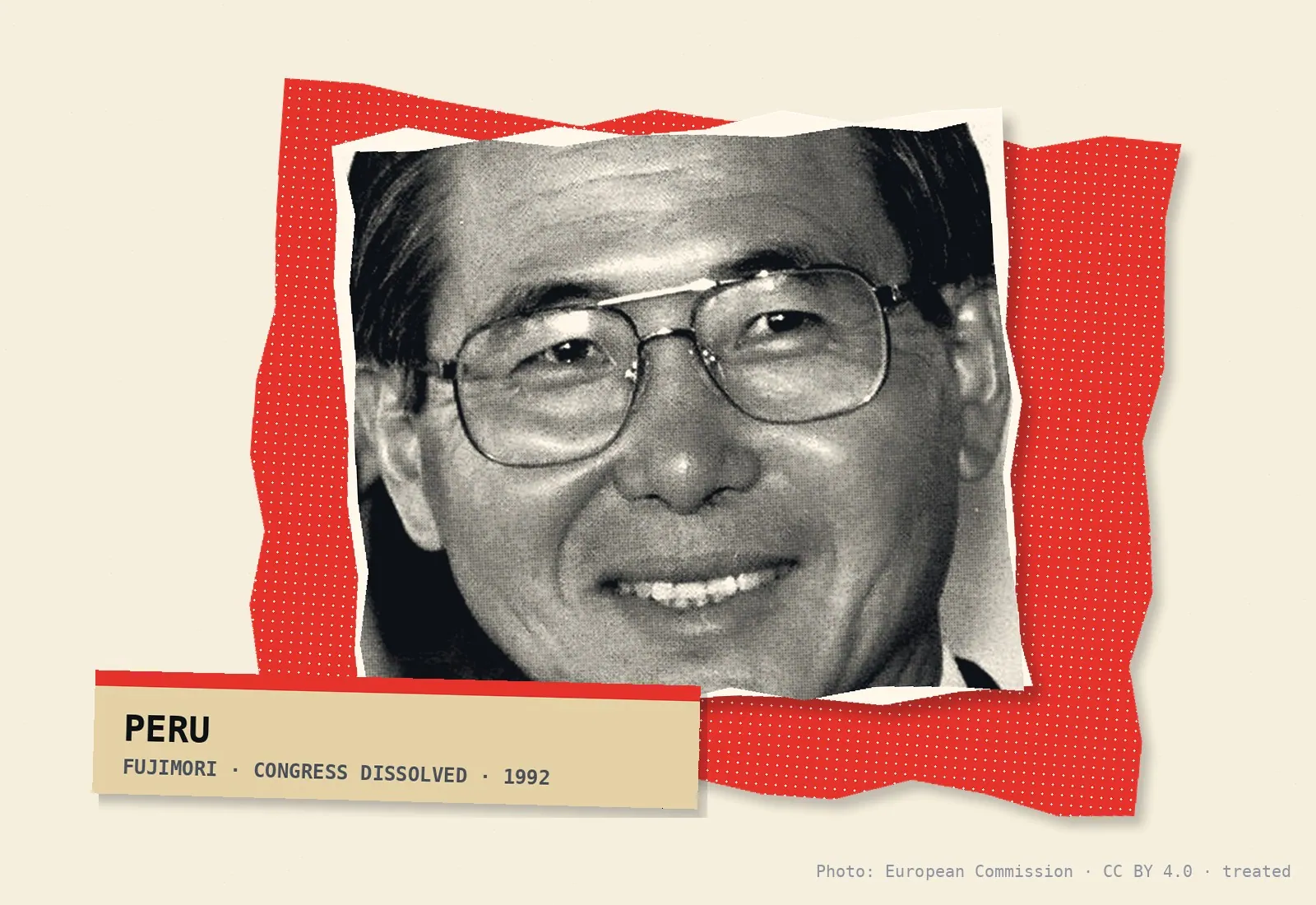
What Fujimori did
- Dissolved Congress and suspended the constitution in a single night, then governed by decree.
- Purged the judiciary, clearing out the judges who could rule against him.
- Used a real emergency—Maoist terrorism and hyperinflation, plus a Congress the public already despised—as the justification for all of it.
- Kept the forms: held elections for a new assembly, wrote a new constitution permitting his re-election, and ratified it by referendum.
- Ran a hidden machine—his intelligence chief, Vladimiro Montesinos, wiretapped rivals and bribed legislators and TV owners on camera.
- Stayed popular the whole time. Approval for the coup topped seventy percent.
The same moves, here
Strip the dates and Fujimori's playbook maps, step for step, onto 2026. The difference is tempo and technique: what he did in one night with soldiers, the Trump administration is doing over months, with personnel rules and procurement.
Fujimori dissolved the Congress that blocked him and sent troops to shutter the courts. By sunrise there was no institution left in Lima with the authority to tell him no.
The watching is now industrial. DHS has authorized Palantir's platform department-wide, and the records are converging on it; a program called ELITE builds target lists from the roughly 79 million people on Medicaid; Clearview's fifty billion scraped face images turn any camera into a query. The silencing runs on money instead of bribes: broadcasters settle lawsuits they once would have fought, the FCC floats license reviews after critical coverage, and universities watch billions in federal funding turn on their politics.
Fujimori had a real emergency—Shining Path terrorism, hyperinflation—and a Congress the public already despised. The crisis made the seizure feel like a rescue, not a robbery.
Here the crisis is being prepared rather than awaited. A presidential directive, NSPM-7, pointed the counter-terror apparatus at "domestic extremism"—and within months federal agencies had invented a category no extremism handbook ever contained, "anti-tech violent extremism," to file surveillance reports on Americans who spoke against data centers at town halls. First the enemies list, then the emergency that justifies acting on it. That is the order of operations.
Fujimori's intelligence chief, Vladimiro Montesinos, wiretapped rivals and bought legislators and television owners with cash across a coffee table—and filmed himself doing it. Watching and silencing were the same job.
The watching is now industrial. DHS has authorized Palantir's platform department-wide, and the records are converging on it; a program called ELITE builds target lists from the roughly 79 million people on Medicaid; Clearview's fifty billion scraped face images turn any camera into a query. The silencing runs on money instead of bribes: broadcasters settle lawsuits they once would have fought, the FCC floats license reviews after critical coverage, and universities watch billions in federal funding turn on their politics.
Fujimori never canceled an election. He held them under a constitution he wrote, with courts he had picked, and won—twice.
Nobody has canceled anything here either. Instead, Homeland Security threatens state election officials with prison over voter-roll demands; a mid-decade redistricting push aims to manufacture House seats before a single vote is cast; and a seventeen-page draft executive order circulated among Trump allies would declare a national emergency to seize federal control of the 2026 midterms. Trump said the quiet part at Mount Rushmore in July: pass the SAVE America Act, "and we will not lose an election for a hundred years."
The coup polled above seventy percent. Peruvians cheered the dissolution of their own legislature as housecleaning—which is exactly what made it survivable.
Popularity is not a guardrail; in an autocoup it is an accelerant. Approval was the thing that let Fujimori's seizure read as a rescue, and it is the reason "half the country supports this" answers nothing about what is being built. The strongest version of the you're-overreacting case—and its answer—is in Am I Being Alarmist?
How it ended
It did not end at the ballot box. Fujimori won re-election under his own constitution, with his own courts, and governed for eight years. What broke the machine was not patience but exposure: in 2000, leaked tapes—the vladivideos—showed Montesinos handing bribes to congressmen and television owners across that coffee table, on camera, one envelope at a time. The public could suddenly see the whole apparatus at once, and the people running it began to defect. Within weeks the coalition dissolved, and Fujimori faxed his resignation from a hotel room in Tokyo. He was later extradited, convicted, and imprisoned.
That is the lesson this site is built on. The autocoup fell to a record the public could finally see and to operators who stopped cooperating once it was visible. Peru got its record from a leak, eight years too late. Ours is being assembled in public, in real time—which is the point of the tracker, and of the levers mapped in Where Refusal Still Works.
One of nine case studies. Other countries have been through this. If you want the long view first, read The Oldest Way to Kill a Republic.
See where these moves sit on the map.
Every parallel above is a live case file in the tracker, with its own receipts.
Open Tracker →